
Planning to Book a Panna Tiger Safari? Just before you plan your visit, let me tell you everything you need to know to decide the best time to visit Panna Tiger Reserve.
Panna Tiger Reserve, located in the Vindhya Hills of northern MP, is one of Central India’s better tiger pockets. Spread over 1,598 sq km, the protected core and buffer zones of the dry deciduous forests, open grasslands, and gorges of the Ken River are crucial for the survival of its population across belts of 576 square kilometer and 1,021 square kilometer.
It is home to Bengal tigers, leopards, sloth bears, wild dogs, hyenas, and chinkaras, as well as 200+ bird species. The Pandav Falls and Khajuraho Temples of Damoh are World Heritage Sites.
Panna is regarded as one of the great success stories in India’s tiger conservation. Tigers were locally extinct within the reserve from 2009, but were reintroduced as part of an ambitious translocation project and are now successfully thriving here 6 years later.
The park is usually open from October 15 to June 15 each year. On the flip side, every season is beautiful in its own way, and when to head on one of these European hot spots really comes down to what you’re after from this break.
Book a Panna Tiger Safari in advance, especially during high vacation seasons when permits sell out rapidly.
Winter Season (October to February) - Best for Comfortable Weather
Winter is Panna Tiger Reserve’s best and most popular season. These months’ 4 to 28 degrees Celsius temperatures make early-morning and afternoon safaris comfortable. On a woodland walk, you quickly find that the monsoon lasts almost until November, with its golden light refracted in the early morning and during animal activity throughout the day.
Who should visit in winter?
- Families with children
- First-time safari visitors
- Birdwatchers
- Nature photographers
Why is winter a great time to visit?
Birdlife is one of the fundamental reasons to come here. From October until February, the Ken River and nearby grasslands are home to large flocks of migratory birds, including bar-headed geese, paradise flycatchers, white-necked storks, and honey buzzards, as well as five vulture species.
Another boon of this season is the wildlife in your backyard. Mammals: Nilgai, Sambar Deer, Spotted deer (chital), Bluebull, Chinkara (Indian Gazelle). Sometimes the latter group is represented by very few hyenas, and sometimes even by a single sloth bear.
Tiger Spotting is Okay, Compared to Summer. Thick vegetation post-monsoon provides better cover for big cats to remain invisible. That said, visitors booking multiple safaris, especially the dawn safari, can see one regularly. Tigers take many more daytime activities because of the cooler temps, which might have led them to rest in the shady spots.
Fourth, January might be cold; the air around the Ken River can fall below 4°C at dawn. An extra layer for when you get up early for those drives.
You should also check the Panna Tiger Safari timing before embarking on your tour so you can accommodate the most suitable slots.

Summer Season (March to June) Best Time for Tiger Sightings
This is the summer for wildlife nerds. High summer temperatures are now recorded, with the mercury reaching a dusty 45 °C by May, more than twenty-one degrees hotter than the March average (24 °C), but it is this very heat that makes tiger spotting so rewarding at Panna.
Who should visit in the summer?
- Dedicated wildlife photographers
- Seasoned safari-goers with a particular interest in tiger spotting
- Travellers are comfortable with extreme heat and want fewer crowds
- Anyone whose previous winter visit left them wanting a closer big-cat experience
Why is summer the best time for tiger sightings?
As the dry season progresses, water levels in bodies of water throughout the reserve decline rapidly. Animals were dispersed over most areas of the forest in winter, but are now funnelled toward the decreasing number of waterholes and to the Ken River. Focusing this way makes predator spotting significantly simpler.
Black amplified 18 Many ungulates are attracted to very high-density sites we call water holes overnight, along with tigers, leopards, and sloth bears. Top game guides know all the hot spots too, and on a chilly pre-dawn morning next to a busy waterhole perched up in the open back of his jeep can be experiences that no winter safari could rival.
The sparse summer vegetation is another major advantage. With far less leaf cover, sightlines into the forest are clear and open. You can spot an animal from a greater distance, follow its movement, and photograph it without obstruction. The park is quieter in summer. Casual travellers avoid the heat, resulting in fewer jeeps, less noise, and a more private safari.
For online Panna jeep safari booking , summer months generally have better permit availability than the busy winter season, making it easier to get your preferred dates and zones.

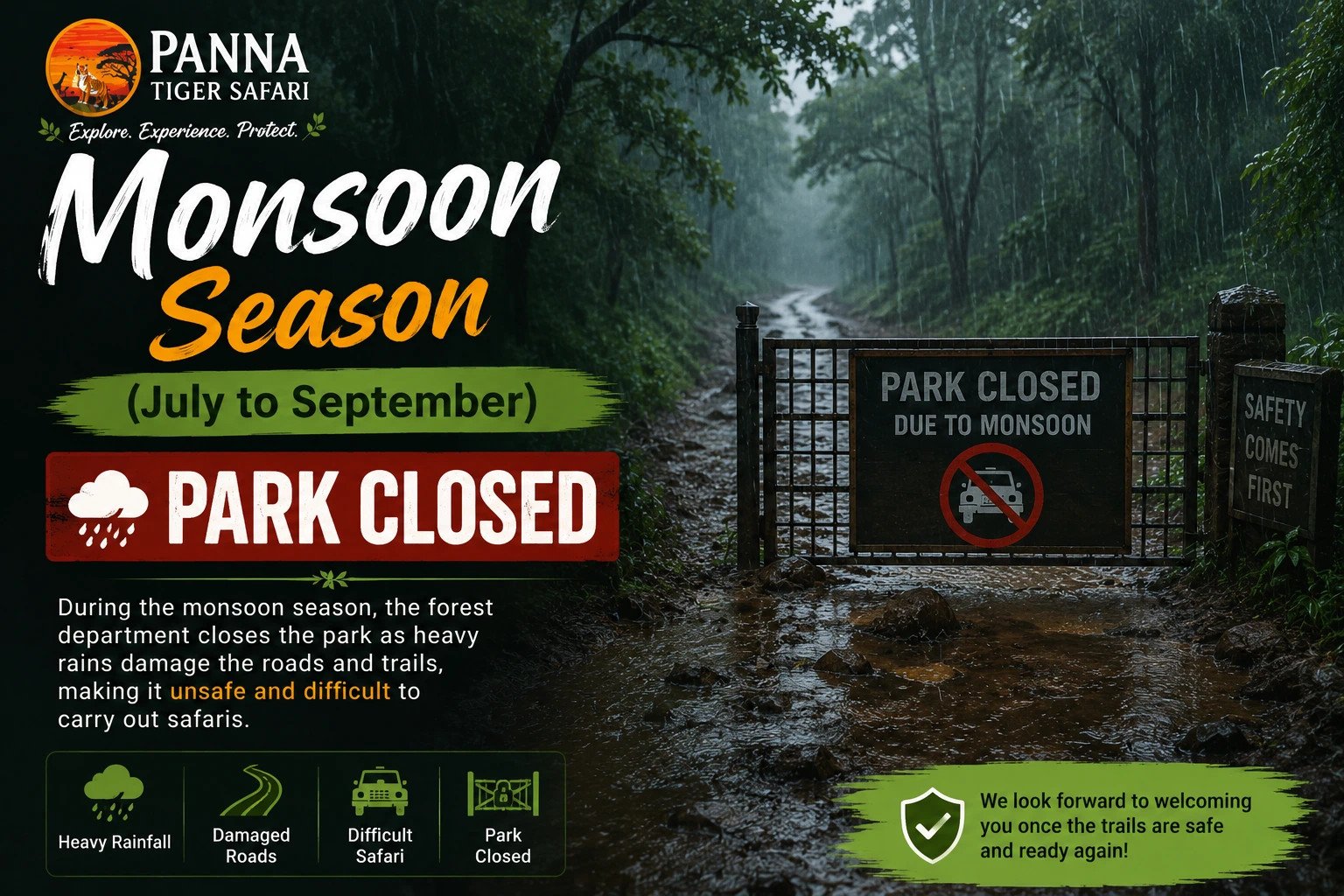
Monsoon Season (July to September) Park Closed
Panna Tiger Reserve remains closed from 15th June and 15th October of every year.
The forest tracks become hazardous and inaccessible to jeeps altogether after heavy rains. All safari operations across the Akola, Madla, Hinouta, and Harsa zones are suspended for the full duration of the monsoon.
The closure is not only about visitor safety. It lets the ecology recover. Grasses grow, trees bloom, water bodies refill, and animals reproduce and remain hidden from human eyes. This was where the annual break, in fact, is key to promoting Panna’s biodiversity.
Monsoon temperatures hover between 18°C and 36° C. The forest is still intensely green, but the Ken River runs full and beautiful to see, now off-limits to tourists. This season augurs in the full brilliance of the Pandav Falls and should have a place on your itinerary if you are visiting this region.
Season at a Glance
| Season | Months | Temperature | Best For |
|---|---|---|---|
| Winter | October to February | 4°C - 28°C | Birdwatching, families, first-time visitors |
| Summer | March to June | 24°C - 45°C | Tiger sightings, wildlife photography |
| Monsoon | July to September | 18°C - 36°C | Park closed - no tourist entry |
The changing seasons write a new tale for Panna. This is very much in evidence when you visit, whether it’s the epic-sized births and sleepy December mornings where our morning songbirds are silenced, or the blast furnace heat of May’s daytime temperatures as the first arrival tiger bounces down, waving everybody away from his position at a waterhole.
FAQ - Best Time to Visit Panna Tiger Reserve
1 – What is the best month to visit Panna Tiger Reserve for tiger sightings?
April dominates, but May is close behind. The Ken River and nearby waterholes are where most tigers congregate during the warmest part of the dry season. Thus, most sightings are assured and frequent.
2 – Is Panna Tiger Reserve open throughout the year?
No. Closed from July to September due to torrential rains.
3 – Is Panna National Park suitable for families and children?
It is comfortable during almost all months, and the birds are diverse, and the place is easy to walk through, making it a great place for families with little kids.